From the founder
The 11,000 I did not know I was spending
I thought I spent 15,000 kronor a month. The median month was 26,000. What I saw when I put every payment into one structure.
3 min readPublished

For a long time I was sure I spent about 15,000 kronor a month. That was my number: the normal things, plus the odd extra here and there.
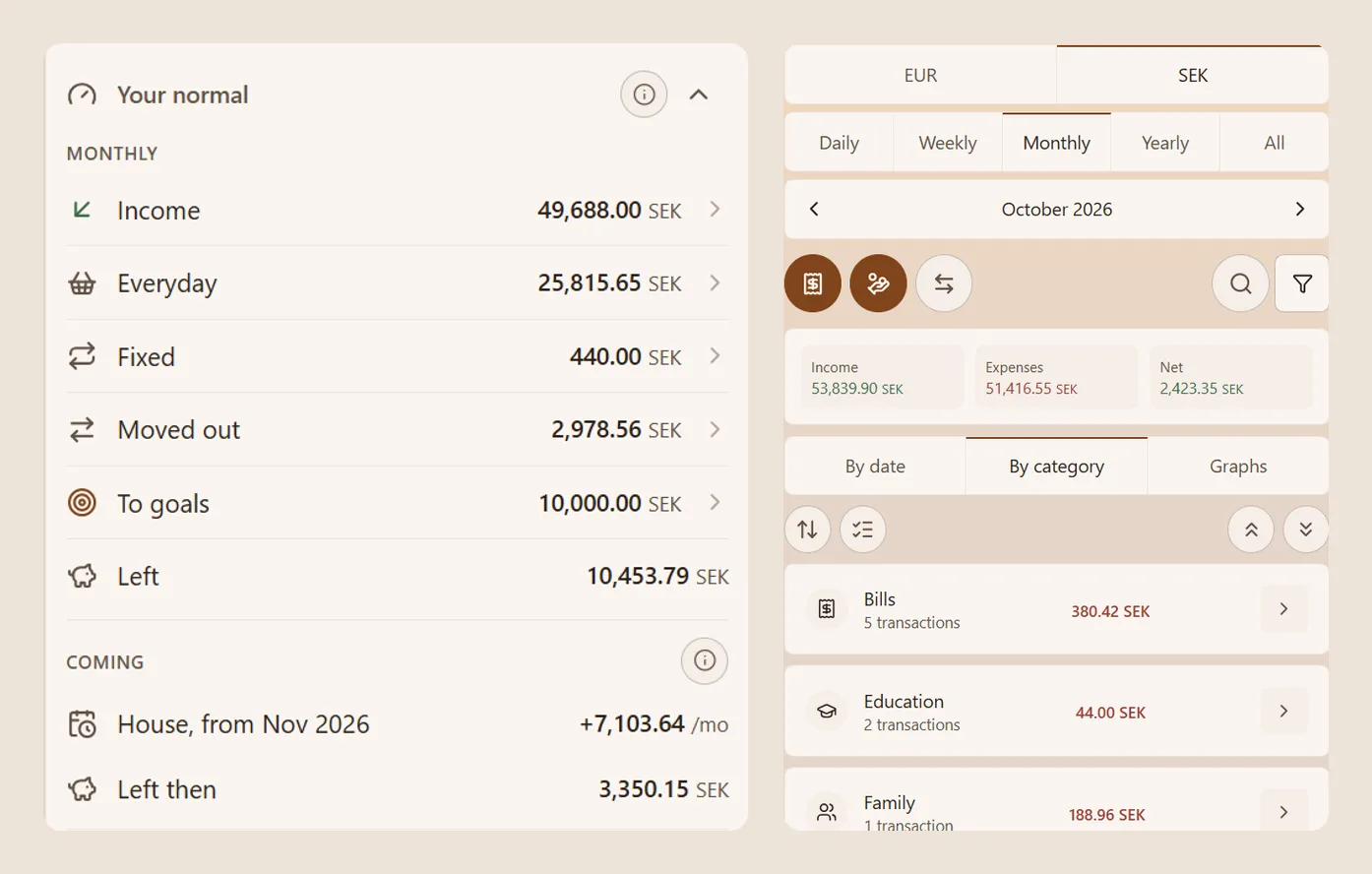
Then I put every payment from the past months into one structure and looked at the median month. It was 26,000 kronor.
Where the 11,000 was hiding
The extras were not one-offs. That was the whole problem. Every month had a few things I would have called ad hoc, and every month they went under a different name, so I never connected them. A payment this month and a payment last month looked like two separate events, when together they were a habit.
Some months it was travel. Other months it was education: a course, a fee, something for learning. Both kept coming back in one form or another, under a different name each time. Together they showed me that my real baseline was not the two or three things I had been counting. It was much wider than that.
One at a time, each of them felt small and reasonable. Added up over a month, and then over many months, they were the gap between 15,000 and 26,000.
How the usual month is worked out
Perfin does this part with plain arithmetic, on the device, with no AI involved. It takes the full months already behind you (at least two; a half-recorded month does not count as usual) and, for each one, adds up what came in, what is fixed because it repeats under the same name, what is everyday spending, and what simply moved between your own accounts. Then it takes the median of each line across those months.
The median matters. One holiday month or one large bill does not pull the usual month up or down the way an average would, so the number describes a normal month, not the average of the exceptional ones.
The result is a handful of lines: income, fixed, everyday, moved out and what is left. When I first saw them side by side, the fixed line was small and honest. The everyday line was the one I had been underestimating, because it was the unnamed middle where all those extras lived.
It is only as good as the records behind it. If payments are missing or sorted wrongly, the usual month is wrong, which is why each line can be opened to show the payments it rests on.
What changed, and what did not
I do not spend less now. I want to be honest about that, because it is the first thing people ask. My habits did not get fixed.
What changed is that I can see where the money goes. I can tell what is fixed, what is everyday and what is truly one-off, and the truly one-off list is much shorter than I believed.
What I can answer now
Once your usual month is a real number, questions that used to be guesses turn into arithmetic:
How big should my emergency fund be? It is a number of months of my real month, not of the one I imagined.
What would a house or a car require of me each month?
What would a trip to Japan cost compared with a normal month?
Why I built something for it
I spent a few months building a small app for this and fine-tuning it on my own messy data: real statements, unclear payee names, the same shop written three different ways. Plenty of tools look good on tidy sample data and fall apart on that, so I kept going until mine did not.
It is called Perfin. I am new at building things, and I am not charging for it. It costs me money to run, but right now I care more about whether it is useful than whether it pays for itself. If the costs get out of hand later, I will say so openly.
What I would like from you
If you try it, tell me what is confusing and what is missing. That is worth more to me than praise. It is free to start.