From the founder
The same payment, from two sources
A hotel charge, a scanned receipt and a bank row can all be the same payment. How Perfin spots the duplicates, and what receipt notes are good for.
3 min readPublished

The moment you collect payments from more than one place, the same payment starts to show up more than once. A bank feed, a statement file, a receipt you scanned, an entry you typed in yourself. If you add them all up, you count some things twice.
That matters more than it sounds. I found that my real month was much bigger than I thought, and it would have been easy to make it look even bigger, by mistake, with duplicates.
A hotel in Gothenburg
In March 2025 I stayed at a hotel in Gothenburg. My bank history shows the same amount, 2,152 kronor, twice on the same day, each with its own card reference. Perfin keeps both as separate payments, because two identical charges can be real: two rooms, or two nights paid separately. It shows them side by side so I can check, and it does not guess.
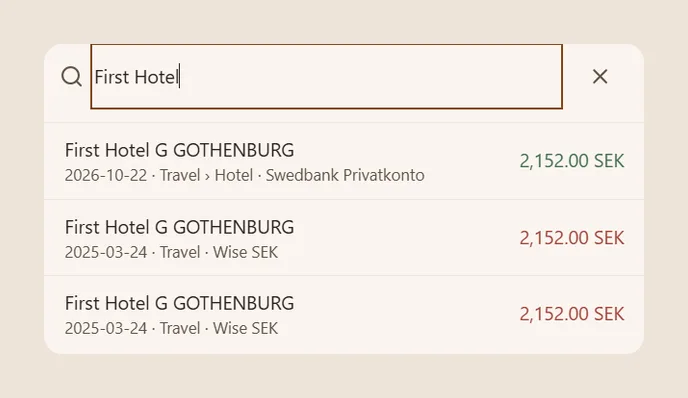
Two identical rows from the same source are for you to judge. The case Perfin does look for is different: one payment that arrives from two sources.
One payment, two sources
For the same stay I had typed an entry by hand on 23 March, so my own records were complete. A day later the bank row arrived: the same amount, 2,152 kronor, one day apart, and a similar name. Those are two sources describing one payment.
Perfin noticed that the two were the same payment and put them in Review matches, side by side, with its recommendation. It asks first; it does not merge on its own. I chose Use bank details, and the payment counted once.
How it decides two rows are the same payment
Perfin compares a bank row with your own entries and scanned receipts on three things: the amount, which counts most, how many days apart they are, and how similar the text is. A row only becomes a candidate when it scores high enough on all three together. If exactly one candidate scores very high, that is treated as an obvious match. If several are possible, an AI model helps rank them so the best one is shown first.
In every case it only proposes. You see the two rows side by side and choose: use the bank details, keep your own text, or say they are different. Nothing is deleted whichever you pick.
It also works the other way round. If the bank row is already there and you scan the receipt later, the scan notices the existing row, tells you it is already in your ledger, and offers to merge the receipt into it.
Why I keep the receipt at all
The bank row says how much. The receipt says what. A scan keeps the items in the note, so groceries and eating out stop being one number and become a list of what I actually buy.
That is useful for planning. With an assistant connected to Perfin (Claude, ChatGPT or Gemini through a connector), you can ask it to look at those notes and help plan your groceries, for example what you buy every week and what you keep buying and not finishing.
Receipt scanning and the assistant connection are on a waiting list for now, while I make sure they hold up. The duplicate check is part of the free start.
What I would like from you
If you have seen a duplicate where two sources of the same payment did not match, or a match that was wrong, tell me. Those cases are exactly what I want to fix.